
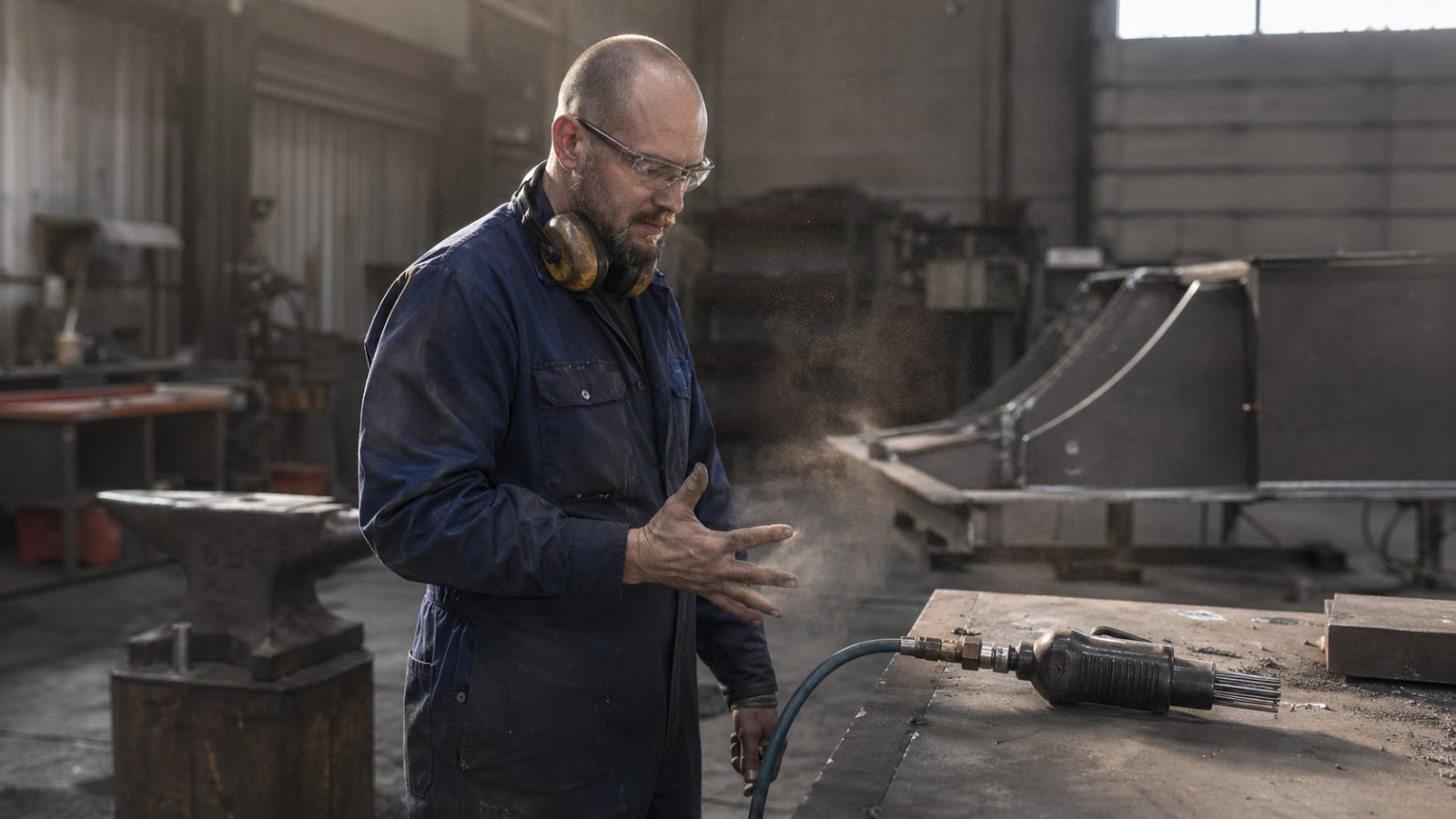
Why the operator's day ends at 2 p.m.
Most production managers know the shape of the day. The morning runs at full pace. After lunch, output drifts down. The drop usually gets written off as motivation, individual variation or general afternoon fatigue. In workshops that run pneumatic tools, there is often a different explanation. The afternoon dip is a measurable result of vibration building up in the operator's hand until it passes a regulatory threshold at a predictable point in the shift.
The mechanism behind the measurable threshold
European workplace rules set two daily limits for hand-arm vibration. They come from EU Directive 2002/44/EC and are implemented in national law across Europe. Examples include Germany's LärmVibrationsArbSchV (2007), the UK Control of Vibration at Work Regulations (2005) and Sweden's AFS 2005:15. All three use the same figures as the directive. Those figures are an action value of 2.5 m/s² A(8) and a limit value of 5.0 m/s² A(8). The A(8) notation means vibration exposure normalised to an eight-hour working day, so shifts of different length can be compared on the same scale. Above the action value the employer has to act to reduce exposure. The limit value must not be crossed.
The link between a tool's vibration level and the time it can safely be used is not linear. It is quadratic. This means the safe time drops very fast as vibration rises. A tool rated at 15 m/s² passes the action value after 13 minutes of actual tool-on time. A tool at 10 m/s² holds for 30 minutes. A tool at 5 m/s² gives two hours. A tool at 3.5 m/s² only reaches the action value after four hours and five minutes. What looks like a small difference on a datasheet turns into several hours of safe working time in practice.
The exposure clock runs on actual tool-on time, not on the length of the shift itself. An operator in weld flux removal, deburring or heavy cleaning can clock 30 to 60 minutes of tool-on time before lunch without thinking about it. For these applications with conventional tools in the 12 to 15 m/s² range, the action value is often passed before the afternoon even starts. From that point the physiological effects begin to become measurable.
Working out where your own tools sit on this curve takes less than a minute. The hand-arm vibration exposure calculator returns the trigger time before the action value and the limit value are reached, given a tool's declared vibration figure. Run the numbers for the three or four tools your operators spend most of their day on. The point at which fatigue starts to bite is rarely a guess after that.
What happens in the body above the action value
Vibration above the action value causes cumulative muscle fatigue in the hand and forearm. Grip weakens. Fine motor tasks get less precise. Concentration falls. These effects are well documented in occupational health research. They show up in three measurable production outcomes. Cycle time per operation gets more variable. Scrap rate rises. Micro-breaks — the short unplanned pauses to shake out the hand, regrip or reposition — become longer and more frequent. Operators often report tingling, numbness and a weaker grip at the end of the shift, rarely at the start.
The consequence for production
The effect across a normal production window is not random. An operator whose tool sits above 10 m/s² hits the action value after a little over half an hour of tool-on time. That typically happens earlier in the day than production planning assumes. From that point on, fatigue accumulates across the rest of the shift. Cutting a tool's vibration level from 5 to 3.5 m/s² adds two hours of safe working time per operator. Across a team of ten, that equals an extra operator-day per shift — without adding an operator. The scale of the underlying problem is well documented. UK HSE records 2,860 reported cases of hand-arm vibration syndrome between 2015 and 2024. The highest incidence falls in exactly the tool categories where operators already feel the afternoon drop. Earlier HSE estimates from the 1990s put around five million British workers in at-risk roles. Newer numbers track reported cases rather than total exposure, but the workforce is still there. The EU-OSHA expert review finds that around one in three European workers is exposed to vibration for at least a quarter of their working time. Construction and manufacturing consistently top the list.
Why the pattern is hard to diagnose at the right level
Production leadership rarely measures tool-on time per operator against the vibration rating of each tool in use. The afternoon drop then gets read as a people issue or a shift-design issue. The structural cause sits in the mix of tools on the floor and in the exposure maths — not in the operator. Without the measurement, the diagnosis is missing. The response lands on staffing, breaks and motivation. The tool choice rarely enters the discussion, even though it is the one parameter that actually moves the threshold in the day.