
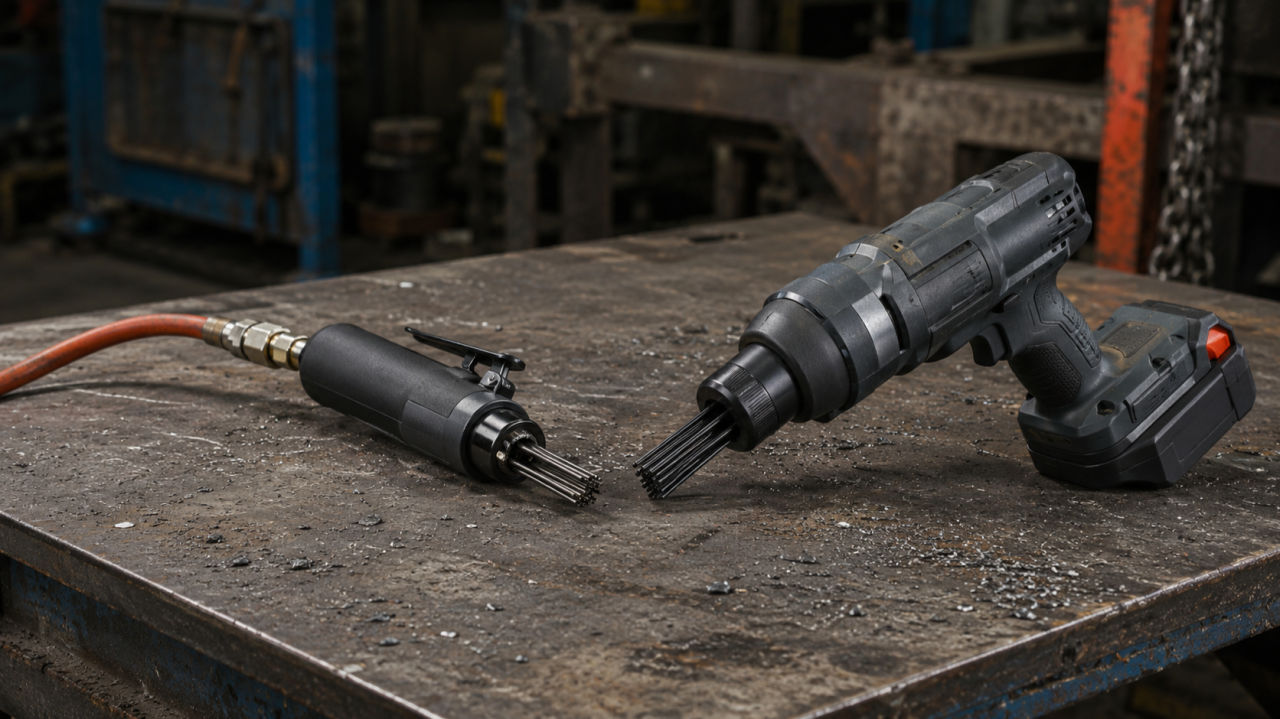
More manufacturers are building battery-powered tools for industrial use. Cordless scalers, grinders and chippers are entering the market. The question surfaces more often in procurement meetings and on production floors: should we switch to electric?
The answer depends on the application, the operating environment and what you are optimizing for. Both technologies have measurable advantages and real limitations that affect safety, productivity and cost.
Where pneumatic tools have the edge
Pneumatic needle scalers weigh around 2.4 kg. An electric equivalent typically lands at 4.5 to 6.5 kg. For operators working overhead or in confined spaces for hours, that difference compounds across a shift. The weight advantage is most pronounced in needle scalers and chippers; for grinders the gap narrows depending on model and battery size.
The power-to-weight advantage is even larger. An industrial pneumatic turbine grinder delivers roughly 1.2 kW per kilogram. A typical 18V battery grinder delivers around 0.36 kW per kilogram, a factor of three.
Duty cycle is unlimited. As long as the compressed air supply runs, the tool runs. Battery tools under heavy continuous load, such as descaling or weld preparation, deliver 5 to 30 minutes per 5.0 Ah battery before requiring a swap, depending on application intensity. Operators doing full-shift material removal work need 6 to 12 batteries per day to maintain throughput.
In environments where explosive atmospheres can occur, pneumatic tools are inherently safe. ATEX regulations apply wherever flammable gases, vapours or combustible dusts are present. That includes oil and gas refineries, chemical plants, paint shops and mines. In these workplaces, pneumatic tools carry no spark risk because they have no electrical components. Electric tools require specialized ATEX-certified enclosures, cabling and periodic inspections, all of which add substantial cost.
Pneumatic motors have fewer moving parts than electric motors. A vane motor consists of a rotor and lamellae inside a housing. No circuit boards, no brushes, no electronics sensitive to dust, moisture or heat. Industrial pneumatic tools reach 2,000-hour service intervals. Brushed electric equivalents require brush replacement every 60 to 120 hours. Brushless electric motors eliminate brush wear but add electronic controllers that are vulnerable in harsh environments. In shipyards, foundries and heavy fabrication shops, simplicity translates directly to uptime.
Where electric tools have the edge
Energy efficiency is the clearest advantage for electric. Compressed air systems convert roughly 9 to 15 percent of input energy to useful work at the tool. The rest is lost as heat in the compressor, pressure drops in distribution lines and leakage. Electric tools, by comparison, deliver 70 to 95 percent of input energy to useful work at the tool, depending on whether they are battery-powered or mains-connected.
Facilities with existing compressed air infrastructure have already absorbed the compressor overhead. The marginal energy cost of adding one more pneumatic tool is far lower than the system average suggests. The efficiency gap matters most when evaluating new installations without existing air supply.
Electric tools are quieter at the tool itself. Typical pneumatic tools produce 85 to 100+ dB(A); electric equivalents operate at 50 to 70 dB(A). In practice, application noise from grinding or chipping often dominates, which narrows the gap at the operator's ear. But in environments with strict noise regulations, electric tools require less hearing protection.
Mobility is straightforward. No compressor, no hose, no air preparation system. For field maintenance, repair work at varying locations or sites without existing compressed air infrastructure, battery tools eliminate a logistical constraint.
Digital integration is simpler with electric tools. Automated torque documentation for quality audits, data logging per operator and connectivity for Industry 4.0 systems are easier to implement when the tool already has electronic controls.
What the vibration data shows
Electric tools are often assumed to vibrate less than pneumatic. Published specifications do not support this. One of the few electric needle scalers with publicly available vibration data is rated at 14.8 to 16.8 m/s² according to its instruction manual. That falls within the same range as standard pneumatic needle scalers at 11 to 19 m/s². The available data is limited to a single electric model, but it demonstrates that switching energy source does not guarantee lower vibration.
Purpose-built low-vibration pneumatic tools achieve far lower levels, with verified needle scaler models rated at 2.5, 3.2 and 3.4 m/s². Vibration level is determined by internal damping design, not by the energy source powering the tool.
What those figures mean for a shift takes less than a minute to work out. The hand-arm vibration exposure calculator returns the trigger time before the action value and the limit value are reached, given a tool's declared vibration figure.
Switching to a tool designed specifically for low vibration is what reduces operator exposure, regardless of whether the tool runs on air or electricity.
Where each technology fits
For continuous heavy material removal in fixed facilities with existing compressed air, pneumatic tools deliver higher power at lower weight. Runtime is unlimited as long as the air supply runs. For mobile repair work without air infrastructure, battery tools eliminate setup time. For workplaces classified under ATEX, pneumatic is the standard choice. For precision assembly with torque requirements, electric offers better digital control.
The decision is operational. Vibration exposure per EU Directive 2002/44/EC, duty cycle requirements, available infrastructure and total cost of ownership across a three-year horizon are the variables that determine the right choice.